

Bookkeeping software helps you prepare these financial reports, many in real-time. This can be a lifeline for small-business owners who need to make quick financial decisions based on the immediate health of their business. Now that you’ve balanced your books, you need to take a closer look at what those books mean. Summarizing the flow of money gross vs net in each account creates a picture of your company’s financial health. You can then use that picture to make decisions about your business’s future. You’ve created your set of financial accounts and picked a bookkeeping system—now it’s time to record what’s actually happening with your money.

Revenue
At some point, hiring a professional to handle in-house accounting may offer cost savings in the long run. For established businesses, accounting firms’ hourly rates can become exorbitant as transactions become more complex. Though many small businesses begin with the owner as the sole employee, it eventually becomes advantageous to hand over accounting functions to a professional. In this situation, businesses may choose to hire inside or outside accountants in accounting firms. At this stage, successful small businesses should consider either outsourcing their accounting needs or investing in accounting software.
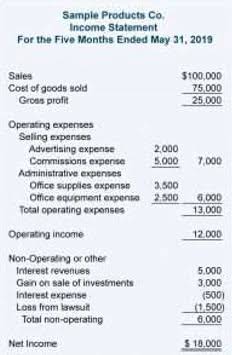
- For example, interest earned by a manufacturer on its investments is a nonoperating revenue.
- Book a demo today to see what running your business is like with Bench.
- It integrates deeply with other Zoho products, such as CRM and Inventory, making it suitable for scaling businesses.
- Instead, depreciation spreads that cost over the asset’s useful life — lowering my tax burden without distorting my monthly profit.
- Popular accounting software options like QuickBooks, FreshBooks, and Xero all offer similar features which allow you to track expenses, profit, invoices, and more on an easy-to-use platform.
- (The depreciation journal entry includes a debit to Depreciation Expense and a credit to Accumulated Depreciation, a contra asset account).
Time Management
Without a clear financial picture, Suspense Account it can be difficult to move your business forward. This can be as simple as a statement showing your current cash position, expected upcoming cash receipts, and expected cash payments for this period. If you’re a small-business owner, you’re probably used to doing everything yourself. You’ve used your entrepreneurial prowess to produce a product or service that your customers need. And avoiding spending any money when you think you can just take care of a task yourself is tempting. Proper record-keeping for small businesses makes the process easier and keeps you compliant with the law.
Small business accounting 101
- A long-term asset account reported on the balance sheet under the heading of property, plant, and equipment.
- If the net realizable value of the inventory is less than the actual cost of the inventory, it is often necessary to reduce the inventory amount.
- You’ll find free templates, checklists, and beginner-friendly guides on VAT, financial reports, and self-assessment.
- Another asset, Office Equipment, may have a fair market value that is less than or greater than the carrying amount reported on the balance sheet.
This section covers the key topics accounting for llc every small business owner should know, explained in plain English and broken into simple, practical steps. While accounting may seem like an overwhelming task, it’s necessary to the success of your business. Having an understanding of the accounting basics will hopefully help you decide if you need to bring in the professionals. There are plenty of resources available, such as software programs or hiring bookkeepers and accountants. Consider hiring an accountant or a part-timer and set aside time every day or every few days to understand your company’s accounting processes. If you do this, you’ll better appreciate the financial implications of your business decisions.
- Mapping this out helps avoid data overload and keeps your systems focused on what matters for sales and accounting.
- In this article, we’ll dive deep into the world of small business accounting.
- A Certified Professional Accountant (CPA) familiar with small business or entrepreneurial accounting is ideal.
- But nothing beats up-front, personalized advice from a certified professional—in this case, a bookkeeper, accountant, or CPA.
- For example, if I close a deal and send the invoice, I record that sale before the payment hits my account.
- However, the company has earned the right to receive the money in seven days.
Review inventory.
Learn about financial statements, bookkeeping principles, accounting principles, financial analysis, budgeting and forecasting, cost accounting, internal controls, and taxation basics. Develop a solid understanding of these key areas to effectively perform accounting tasks, interpret financial data, and make informed financial decisions. This involves maintaining detailed and organized records of all business transactions, including income, expenses, assets, and liabilities.
- Whether you handle your own records or hire a professional, mastering the basics of bookkeeping will set your business up for long-term success.
- A balance sheet is a snapshot of the business’s financial standing at a specific point in time.
- Accounting is like a powerful machine where you input raw data (figures) and get processed information (financial statements).
- Although this may seem overwhelming, you don’t have to be a certified public accountant (CPA) to understand the accounting basics that will help with your business’s success.
- It helps you understand where your money goes and ensures you don’t miss out on deductible expenses come tax time.
- The quickest way to improve your net profit margin is to either decrease your expenses or increase your revenue by raising prices, selling more, or upselling your products and services.
- Knowing how to record financial transactions is important, even if you don’t have to do it yourself.

Tech-savvy business owners or those familiar with accounting principles typically use accounting software. Digital bookkeeping offers a much quicker method than manual calculations. Accountants calculate cash flow by making adjustments to a business’s income statement. Through addition and subtraction, bookkeepers remove non-cash items and transactions from the net income. Components of a cash flow statement include operating activities, investing activities, and financing activities.